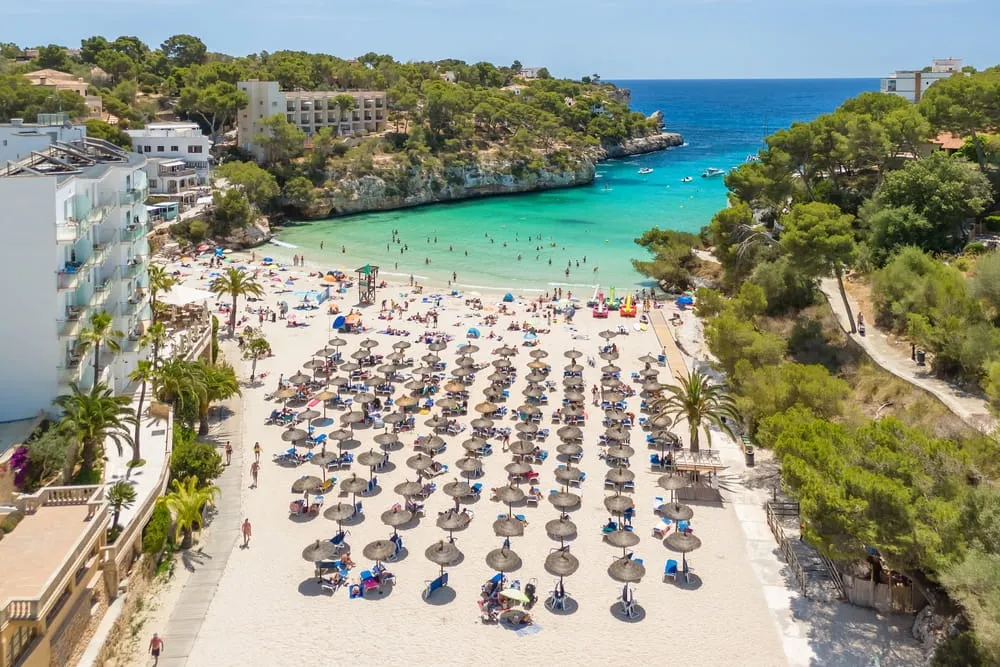
Tourism remains one of the main driving forces of the Spanish economy. This summer, record hotel occupancy rates and tourism-sector profits were reported across most of Spain’s autonomous communities. Coastal destinations remained the most attractive, although rural tourism also reached very high levels.
Record figures across Spain’s regions
The Valencian Community ended August with hotel occupancy at 92%, almost 1% higher than last summer. Positive figures also came from Catalonia, where hotels broke records for the number of tourists in July; Extremadura, which is expected to approach the two-million-visitor mark by the end of 2026; the Canary Islands, where occupancy was around 85%; and Galicia, where average occupancy stood at around 72%, helping to increase the sector’s profitability.
One of the main factors behind the season’s success was the total solar eclipse, which could be observed in many parts of Spain. La Rioja is particularly noteworthy: the phenomenon led to a sharp increase in rural tourism and an influx of foreign visitors, with their share reaching 80% in some establishments.
Overall, Spain is showing very positive results for the tourist season. However, adverse natural phenomena such as forest fires have left their mark on some regions, particularly Aragon and several areas of Andalusia.
Aragon and Andalusia: the impact of fires and heat
The tourist season in Aragon was marked by two completely different realities. Forest fires reduced tourist flows in the Cinco Villas region, while in the Pyrenees and the province of Teruel the overall summer balance was maintained. Nature and mountain tourism helped partially offset the impact of the fires on some of the autonomous community’s main tourist centres.
In addition, summer produced mixed results in Andalusia depending on the specific area. In the province of Cádiz, hotel occupancy remained at a very high level: 88.3% in July and around 92% in August. Coastal destinations such as Rota, Chipiona and Conil stand out in particular, where this figure reaches 96%. In Huelva, August ended with an occupancy rate of 89.45%, although industry representatives warn of a reduction in the average length of stay.
By contrast, hotel owners in Seville estimate summer occupancy at around 60%, below previous years, and attribute the decline to the deterrent effect caused by successive warnings about “heat waves.” The sector hopes to recover in autumn thanks to events such as the Flamenco Biennial.
Tourism remains one of the pillars of Spain’s economy
Ultimately, 2026 will end by once again clearly demonstrating the strength of Spain’s tourism sector. Nevertheless, major fires and extreme heat pose a certain threat to the industry, which, according to the latest data from the National Statistics Institute (INE), accounts for 12.6% of national GDP.